Wednesday, January 11, 2012

Cow Patties & Big Pharma

We’ve been reminded frequently during this seminar that the vast majority of India’s 1.2 billion people live in rural areas where access to healthcare is spotty at best. The reasons for the lack of quality healthcare outside urban areas are many, including lack of infrastructure, a largely impoverished population without means to pay for care; the very low level of public health care spending in India; and the lack of qualified healthcare providers particularly outside of the larger cities. Each of these factors influences the other; for example, we learned at the Public Health Foundation of India that there is a 70% absentee rate of doctors in public rural health facilities. A physician is hired for a job, but he fails to show up at the public facility 70% of the time because he can make more money seeing patients privately than the public system pays him. These factors create something like a perfect storm of inadequate healthcare, and what’s left behind is a country with one of the world’s 10 largest economies, producing health outcomes in its poorest states that are on par with Sub-Saharan Africa and struggling nations like Bangladesh.

As an MBA student, what I’m about to write may be considered sacrilege, but I work for a charitable, nonprofit healthcare organization, and I cannot help that I am fully indoctrinated in that model! I am fascinated that organizations like Novartis and Sanofi Aventis look at India’s public health failure in the rural areas and see a business opportunity. It brings to mind the artfully-stacked piles of cow dung patties we saw in the semi-urban villages outside of Delhi. These pharma companies are following the steps of that first guy who so long ago must have picked up a pile of poop, and said to himself, “this smells awful, but I bet we can use it for fuel.”

While personally my left-leaning perspective leads me to doubt that private enterprise can ever be trusted on its own to do right by individuals and communities as a whole, I have to acknowledge that business moves fast while government… well, lately it seems like the world-over, government just doesn’t move. Novartis in particular is working in rural communities towards improving health through its Arogya Parivar Rural Program. Of course their true intent is to sell these people drugs, and our guest speaker Anirban Roy who heads the program was forthcoming about that, but if Novartis sells medication that the community needs, at prices they can afford, while also improving the public’s awareness of other important health concerns, is there a problem? Well, at least for now, Big Pharma’s activities may be one of the most effective, if not the only, public health projects that the rural communities have going. I just hope someone is keeping an eye on them!

Public – Private partnership is a catch phrase we’ve been hearing a lot over the last week and a half, largely in relation to how private hospitals will provide care to those who cannot afford to pay. If we can compare health care in India to crossing the street in India, I feel like what we are seeing is the Private sector taking the Public sector by the hand and leading them into traffic. The only way to get anywhere here is to step in front of on-coming vehicles, and it seems like the Public sector isn’t ready to lead the way across the street quite yet.

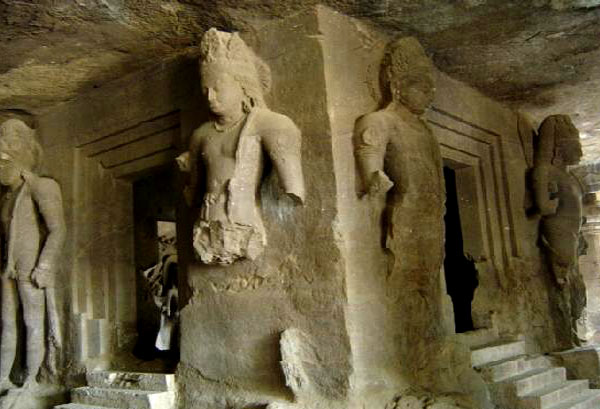
Elephanta Caves

Lessons from the  Elephanta Caves: Namaste!, Perspectives, and Creating with Awareness.

So far, on the Indian Field Seminar, we have visited several healthcare sites ranging from premium hospitals like Max Healthcare to community health centers in rural villages and urban slums. We visited large pharma companies like Glaxosmithkline, research institutions, and even the Public Health Foundation of India, to mention a few. All generously welcomed our class and showed us extremely impressive hospitality.

All had different perspectives to offer. But, what did they all have in common? And, what did any of this have to do with our trip to the Elephanta Caves?

Well, I firmly believe that in order to truly understand a foreign market like the Indian healthcare system, one must also have an understanding of the surrounding culture and philosophy in numerous contexts. This would be difficult to achieve by simply visiting sites without an understanding of the reasoning or explanation of the surrounding culture. Cultural exposure is so important to truly understand different populations.

As tourists at the Elephanta Caves, it would have been very easy for us to pass through the caves, taking pictures, simply appreciating the awe inspiring and symbolic edifices that had been carved out of the side of the mountain, all without knowing the cultural significance behind them. Luckily, we had a great tour guide who insisted that we listen rather than take pictures. This would not be a normal tour.

As we moved from edifice to edifice around the cave, the lifeless edifices came to life. They were no longer statues carved into the mountain. They had meaning and a significance that a camera or video could never capture.

But the "aha" moment didn't occur until the guide pointed out the importance of perspective, especially as one walked from edifice to edifice. It was only from specific places in the cave that one could peer through openings in the caves to view another statue. Capturing this perspective would require special attention to detail, otherwise it would be grossly overlooked. These unique perspectives also carried a deep cultural and sometimes philosophical meaning. It was clear that those who carved the edifices "created with awareness".

Toward the tour's end, our tour guide, who had attracted other tourists, spoke about the meaning of "Namaste!" A traditional Indian greeting, which when translated to Hindi means "not me, you", as our tour guide explained.

According to Wikipedia, Namaste also means "I salute or recognize your presence or existence in society and the universe."

As we conversed with CEO's and other community health leaders, a passion and desire for healthcare innovation was conveyed and it became evident that they brought this "Namaste" philosophy to the Indian healthcare system as they worked feverishly to reach populations near and far, even those in rural areas, where only 60% currently have access to medicine. Their goal? To provide low cost, accessible healthcare.

It seems that of those who held this philosophy, the most successful leaders created innovation with high awareness.

For example, on our visit to the Council of Scientific and Industrial Research, one of the scientists showed us a genomic map of India that highlighted areas of differing genomic polymorphisms within the population. These differences, according to the scientist was significant enough to cause differences in a drug's efficacy and ultimately the body's response to medicinal drugs-completely fascinating.

However, as the scientist passed around his "genomic card," which looked like a debit card, complete with validation dates, I wondered about the practical application of such a rich source of information, only to learn minutes later that while he had this genomic card, there was no current market to utilize this information, and he had no current plans to collaborate with other institutions How would others become aware of this information? How would it be used successfully? What was the plan? What was the larger perspective?

In contrast, look at Arogya Parivar, Novartis' rural health program (the first of its kinda by a large pharma company) ,which employs a "social business model," that other companies are attempting to duplicate as we speak. It was created with an awareness of sustainability. Self-sustainable, this program broke- even within 30 months of its inception. As a result, the program is successfully able to offer care in the long term, providing a platform to address rampant diseases in rural areas.

This shows the importance of creating with awareness, especially during innovation!


Namaste!!

Whatever Floats Your Goat

Did you know that in Mumbai, at temperatures over 80 degrees, goats are so cold they need to wear sweaters? On my first day in Delhi I was amazed at how many dogs were wearing coats. Although you might think that these are simply stray dogs wandering through the market looking for food, it was very apparent that these are pets who are loved. As we walked through some of the Dharavi housing yesterday we saw a number of goats wearing covers ranging from a burlap sack to a brand-new orange sweatshirt. When asked, the people explained that it is very cold out, and they didn't want the goat to get cold. And frankly, after living through a Mumbai summer, the goat may very well be acclimated to the heat. Here is yet another example of how my preconceived notions are being challenged as I experience India in so many ways.

I was amazed by the extensive work that Vaatsalya is doing to ensure excellence in patient care and operations. I was not prepared today to hear a presentation on getting hospital certification after my experience with the rural health facilities we saw in Palwal. Although they were clearly providing services for the public good, the difference in approach was completely dissimilar. I hope that organizations such as Vaatsalya can continue to find ways to improve patient care and their bottom line in the rural, lower income market.

The Unspoken Truth

It has been reported that there are large amounts of corruption in the Indian healthcare system. We have not spoken much about the corruption as we don't want to offend someone or question part of the culture of business in India. Today, however, I met two people who spoke honestly about corruption in the system.

First we had a site visit with the corporate office of Vaatsalya. They are a private company building a network of hospitals for semi-urban areas at affordable prices. The company, which was started in 2005, is not profitable. They also are adamant about not receiving bribes. The executives today told us that they would be profitable if they accepted the bribes which are standard in many similar healthcare organizations.

This evening I had dinner with an executive in Bangalore. In the informal and congenial setting, we were able to ask about the prevalence of corruption. He explained that in his twenties, he was adamant about not giving or receiving bribes. While he is still adamant about curbing the corruption, he also admits that in order to get business done in India, there are some bribes that must be made.

The younger generation apparently is less likely to be part of the corruption. As this population ages, perhaps the corruption will subside. Until then, it is part of getting things done in India.

Mumbai

After being sick in Delhi for 3 days, I finally feel better in Mumbai. The sunshine might have something to do with it - it's beautiful here. We arrived on Saturday, which was our shopping day. I got to barter with the street vendors for some gifts. It was fun, but I feel a little guilty since they could probably use the few hundred rupies more than I could. This morning we visited the Elephanta Caves off the coast of Mumbai. We took a rickety, wooden boat to the island, but the ride was actually relaxing. I didn't expect the island to be as touristy as it was though. It was very crowded and on either side of the long path we had to walk up to the caves were vendors trying to sell crafts or t-shirts. The caves themselves were incredible. Our guide showed us the main cave, the Shiva cave, with carvings all depicting the legend of the god Shiva. The rest of the day we spent wandering around Mumbai, trying and failing to find a temple. Before I left for India, people kept telling me that the amount of poverty is shocking. It definitely is. Children constantly followed us with their hands reaching out for money. People live on busy streets here - their kitchens and bathrooms are sidewalks. The area we're staying in is one of the nicest in Mumbai, and in this same area we saw people giving their baby a bath and cooking on makeshift stoves right next to traffic. It can be really difficult to watch at times. At the same time, they make their living on these streets selling crafts, clothes, and food. I heard that the government could force the homeless off the streets, but fortunately remains relaxed about it. I have to wonder where all of these people would go, and how worse off they would be if the city cracked down on them.

Tuesday, January 10, 2012

Is For-Profit that bad??

Man…. India can really take a person down. Unfortunately, I was not able to join the group today because I got a stomach bug. We were pre-warned about getting sick, but I didn’t realize it would affect so many people. With that being said, seeing India is worth the illness, and you just have to be careful when you visit.

So, yesterday we spoke with three big pharma companies, Novartis, Sanofi, and Cipla. The first two discussed their rural program initiatives, while the third spoke about their international development.

Novartis’ Arogya Parivar rural program involves a 360 approach to getting medicine into rural India. It is a for-profit model that entails investing in all aspects of the rural health care from education to infrastructure. Furthermore, they package the medicine in small dosages to make it more affordable to their target customers.

Novartis said they went for the for-profit model instead of a CSR direction because it made the program more sustainable. If the program was a CSR then it could be subject to disbandment during economic downturns. Therefore, the for-profit model insures sustainability and sustainability insures reaching more rural areas.

In summation, Novartis has been able to achieve what so many NGO’s have failed at, so should we rethink our approach…..